
How Many Batteries Does a 3 kW Solar System Need?
Four 12 V batteries for a 48 V hybrid or off-grid system, and none for on-grid. How much backup that gives, and how one lithium pack compares.
Updated 15 September 2026
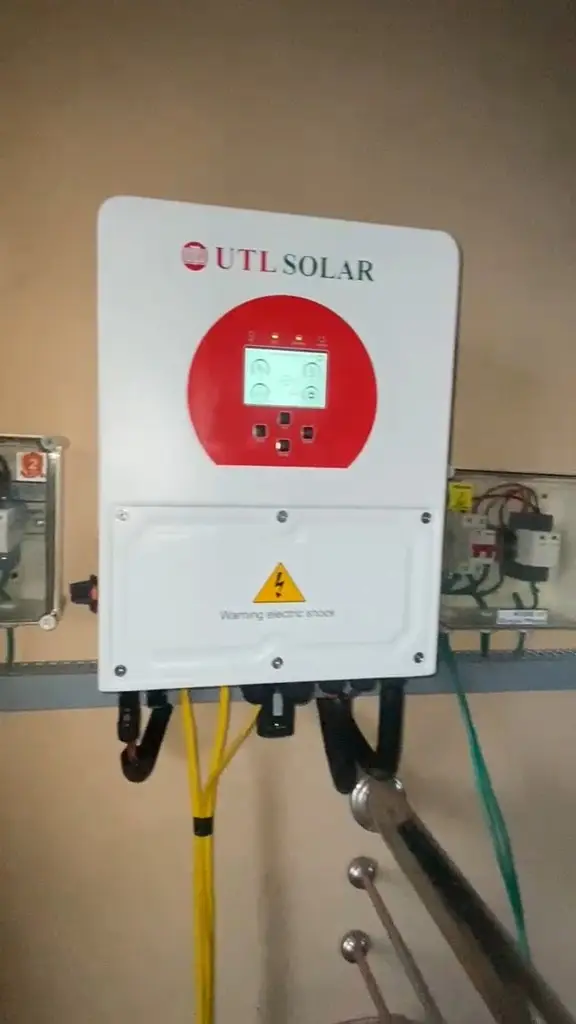
Four. UTL’s 3 kW hybrid and off-grid kits both run their batteries at 48 volts, which takes four 12 V, 150 Ah tubular batteries (UTL UST1560) connected in series. An on-grid system has no batteries at all.
What UTL puts in its kits
| Kit | Inverter | Panels | Batteries |
|---|---|---|---|
| 2 kW, 48 V hybrid | Sigma248 | 6 × 335 W | 4 × UST1560 |
| 3 kW, 48 V hybrid | Sigma348 | 9 × 335 W | 4 × UST1560 |
| 3 kW, 48 V off-grid | Gamma 348 | 9 × 335 W | 4 × UST1560 |
| 5 kW, 96 V hybrid | Sigma596 | 16 × 335 W | 8 × UST1560 |
The number of batteries depends on the voltage. The 2 kW and 3 kW kits both take four batteries because both run at 48 V, while the 5 kW kit runs at 96 V and takes eight.
How much backup four batteries give
Four 12 V, 150 Ah batteries store 7.2 kWh on paper, but you can’t use all of that every day. Lead-acid batteries last far longer when they aren’t regularly drained below about half, and the inverter loses some energy in conversion, so we plan on roughly 3.2 kWh of everyday backup. Both of those allowances are our own general planning figures; UTL doesn’t specify them.
| Running at once | Load | Backup |
|---|---|---|
| Fans, LED lights, a TV and the wifi router | 300 W | about 10.8 hours |
| The same, with a refrigerator running | 500 W | about 6.5 hours |
| Add a desert cooler and a small water pump | 1000 W | about 3.2 hours |
An air conditioner changes the picture. A 1.5 ton AC can use up that everyday capacity in two to three hours, so running one through a power cut needs a far bigger battery bank. How much solar a 1.5 ton AC needs covers that case.
One lithium pack instead of four tubulars
A single 48 V, 100 Ah lithium iron phosphate pack (UTL’s version) takes the place of all four batteries in a 48 V system. It holds 4.8 kWh, and UTL rates it for 3,000 to 3,500 cycles at 80% depth of discharge, so more of it can be used every day.
The first difference you notice is weight: about 40 kg for the lithium pack, against roughly 230 kg for four UST1560s. The inverter has to support lithium charging, so check that before swapping one in. Lithium or tubular goes through the choice.
Can you add batteries later?
Not one at a time. A 48 V system can’t take a fifth 12 V battery, because batteries go in as a matched set. More backup means higher-capacity batteries, or a second matched set if the inverter’s charger can handle it. Mixing old and new batteries in one set wears the new ones out early, so it pays to decide the bank size at the start.
Do you need batteries at all?
Only for backup. An on-grid system needs no batteries, costs less and gets the same subsidy, but it switches off during a power cut. If cuts are rare where you live, that usually wins. On-grid, off-grid or hybrid explains the trade-off.
Questions we are asked
Can I use two batteries with a 3 kW system to save money?
No. The Sigma348 and Gamma 348 inverters in UTL's 3 kW kits expect a 48 V battery bank. Two 12 V batteries make 24 V, which those inverters won't run on.
How long do the four batteries last?
UTL gives the UST1560 a 60-month warranty. How long they last beyond that depends on how deeply and how often they are discharged, and whether they get topped up with distilled water on time.
Does a hybrid system with batteries still get the subsidy?
Yes. RSK Solar Energy's hybrid systems are grid-tied and net-metered, so they qualify for PM Surya Ghar the same way on-grid systems do, up to ₹78,000 for a home.