
How Much Solar Do You Need to Run a 1.5 Ton AC?
Around 3 kW covers a 1.5 ton AC used 8 hours a day. How to work it out from your AC's energy label, and why running one on batteries is a much bigger job.
Updated 15 September 2026
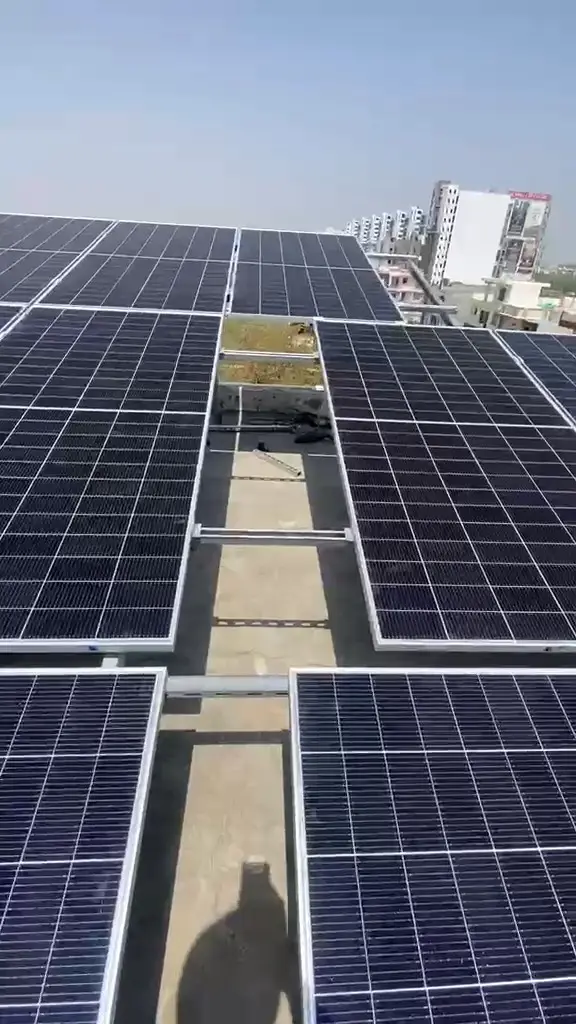
About 3 kW of panels, for a 1.5 ton AC used around 8 hours a day. That matches the AC’s average daily units with solar generation across the year. The panels don’t run the AC at night, though. After dark, the power comes from the grid or a battery.
The calculation
A 1.5 ton inverter AC typically uses around 1 to 1.4 units an hour on a hot Punjab afternoon, and less once the room has cooled. The table uses 1.2 units an hour as a working figure. Your AC’s BEE star label is a better starting point: it shows the rated yearly consumption in units, based on 1,600 hours of use, so dividing that by 1,600 gives a rough units-per-hour figure for your model.
We plan on about 135 units a month from each kW of panels in Punjab, averaged over the year. With TOPCon panels, output can reach up to about 180 units per kW in the sunniest months. These are estimates: real output depends on the roof’s direction and shade, dust, the weather and the panels and inverter used.| AC use a day | Units a day | Panels to match | Nearest system |
|---|---|---|---|
| 6 hours | 7.2 | 1.6 kW | 2 kW |
| 8 hours | 9.6 | 2.1 kW | 3 kW |
| 10 hours | 12.0 | 2.7 kW | 3 kW |
Summer generates more than the yearly average, which helps, since summer is when the AC works hardest.
In Punjab, the AC is often what crosses the 300-unit line
An AC used 8 hours a day adds roughly 288 units a month. For a home that was comfortably under 300 units, that is enough to cross the line, and once a general-category home crosses it, PSPCL charges for every unit used, starting from the first. That is why the AC so often decides whether solar pays here. Is solar worth it with 300 free units has the numbers.
On-grid: the meter does the balancing
With net metering, the panels don’t have to power the AC directly. Daytime generation supplies the house first and any surplus goes to the grid, and at night you draw from the grid. The meter nets the two out over the billing cycle, so an on-grid system is sized on the units you use, and the AC’s running load doesn’t set the size.
Running an AC on batteries is a bigger job
Off-grid, or during a power cut, the inverter has to carry the AC’s load and the batteries have to hold the energy. Four 12 V, 150 Ah tubular batteries give about 3.2 kWh of everyday backup, which a 1.5 ton AC gets through in two to three hours. Cooling a room through the night on batteries takes a much larger bank and inverter, and it rarely makes financial sense. How many batteries a 3 kW system needs goes through the backup maths, and two ACs on a 5 kW hybrid shows a daytime setup that works.
Size it from your own bill
The AC is one load among many. The calculator works from your whole PSPCL bill and recommends the smallest system that takes it to zero.
Questions we are asked
Can a 1 kW solar system run a 1.5 ton AC?
Not on its own. 1 kW of panels makes roughly 3 to 4 units on an average day, which is less than a 1.5 ton AC uses in a single evening of cooling.
Does a 5-star AC make much difference to the solar size?
Yes. A higher star rating uses fewer units for the same cooling, which can bring the system you need down by about a kilowatt for a heavily used AC.
Will the subsidy cover a system sized for my AC?
For a home, yes. The PM Surya Ghar subsidy applies to on-grid and hybrid systems, up to ₹78,000 for 3 kW or more.